

Learning how to build a daily routine doesn’t mean planning every minute of your day. You don’t need another schedule that tells you what to do at 4:15 PM when your meeting is already running late.
Instead, build your day around a few simple anchors that still work when plans change. For most people, the useful points are midday, the transition out of work, and the evening wind-down.
These anchors give your day some structure without turning it into another checklist to manage.
Journal, water bottle, and blanket as simple essentials for making a daily routine stick.
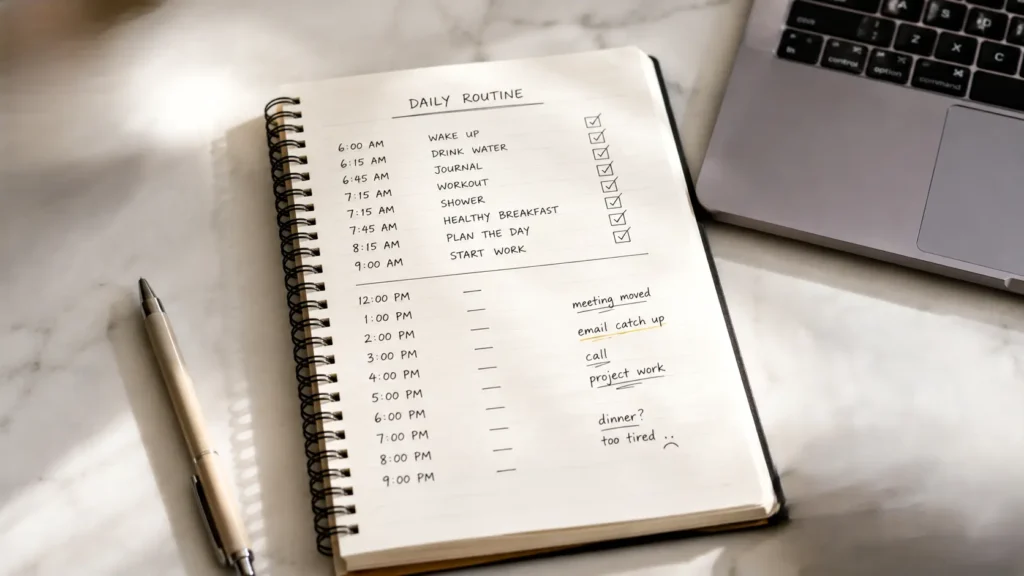
Why Most Routine Advice Stops at Breakfast
Most advice on routines focuses heavily on the morning: wake up early, drink water, journal, exercise, and start the day with a clear plan.
While these habits can create a strong beginning, they don’t address what happens once the day is underway.
- Work demands change.
- Meetings run longer than expected.
- Planned breaks get replaced by another task.
- Your energy and focus can decline as the afternoon progresses.
A morning routine can give you a strong start, but it cannot structure the entire day on its own.
What Happens After Breakfast?
Work has a way of interrupting even a well-planned morning. That’s why a practical routine needs a few points of structure after breakfast too, especially around the parts of the day when your focus, boundaries, or energy tend to slip.
The Three Points Where Your Day Actually Falls Apart
For many busy people, the hardest parts of the day aren’t necessarily the busiest ones. They’re the transitions:
- when afternoon focus starts slipping
- when work follows you home
- when the evening disappears before you have time to unwind
1. The Midday Slump
For some people, focus becomes harder to maintain in the early afternoon, particularly after a demanding morning or a long stretch without a proper break.
This isn’t necessarily a discipline problem. It can be easier to manage when you plan around it rather than constantly fighting through it.
2. The Post-Work Transition
You close your laptop, but your brain doesn’t always close with it. Work thoughts follow you into the kitchen, the shower, or the couch because nothing has clearly marked the end of the workday.
3. The Evening Wind-Down That Never Arrives
You mean to read, stretch, or simply sit still for a few minutes. But instead, you end up scrolling, half-watching something, and staying awake later than you intended without really knowing why.
These are the moments worth building around because they tend to happen even when the rest of your schedule changes.

How to Build a Daily Routine That Works for You
If you’re wondering how to build a daily routine that survives a real, unpredictable day, don’t start by planning every hour.
AT A GLANCE
Build your day around three daily anchors: a midday break, a clear end-of-work signal, and one small evening habit.
A routine anchor is a repeatable point in your day that gives you structure without requiring an exact time. The timing can change, but the purpose stays the same.
Start with one anchor for each point where your day tends to lose momentum:
1. Midday
Take a 10-minute break away from your screen at roughly the same point in your day.
- Walk around.
- Eat something away from your desk.
- Simply sit somewhere else for a few minutes.
The point is to interrupt the work cycle before you’re completely drained.
2. Transition
Choose one small, physical signal that tells your brain work has ended.
- Change your shirt.
- Take a five-minute walk.
- Close your laptop and put it in another room.
The specific action matters less than doing it consistently.
3. Evening
Choose one thing that happens before your phone does.
- Drink water.
- Read a page of a book.
- Dim the lights.
- Follow a simple self-care ritual.
Keep it small enough that doing it feels easier than putting it off.
If a simple self-care ritual is part of your evening, these self-care products for women I actually use every week offer a few practical options.
Give Each Anchor a Smaller Version for Difficult Days
Some days, even a 10-minute break or a short walk feels difficult to fit in. Rather than skipping the habit completely, give each anchor a smaller version that requires less time.
| Daily Anchor | Normal Day | Difficult Day |
|---|---|---|
| Midday | Take a 10-minute break away from your screen. | Step away for two minutes. |
| Transition | Take a short walk after work. | Close your laptop and leave your workspace. |
| Evening | Read a page or follow a simple self-care ritual. | Put your phone down briefly before going to bed. |
The smaller version isn’t something you need to do every day. It’s there for the days when your usual routine isn’t realistic.
On difficult days, smaller habits can help you maintain some structure without forcing the full routine. These 5-minute habits that actually stick are a practical place to start.
How to Keep Your Routine Flexible When Plans Change
A routine becomes difficult to follow when every habit depends on happening at an exact time. If a meeting runs late, you shouldn’t have to squeeze your entire routine into the remaining hours.
Give Each Anchor a Flexible Window
Your midday break might happen at 1:40 PM one day and 2:50 PM the next. The important part is making room for it rather than abandoning it because the original time has passed.
If an Anchor Keeps Getting Skipped
If an anchor repeatedly gets skipped because of your schedule, change its timing first, then reduce the action if needed, rather than adding more reminders.
If you keep missing the same anchor, the problem may be the size or timing of the habit, not your consistency.
Schedule vs. Anchor
A schedule tells you when to do something.
An anchor tells you what part of your day to protect, even when the timing changes.
How to Extend Your Morning Routine Into the Rest of Your Day
Start With What Already Works
A morning routine helps you start the day, while a daily routine provides structure across the hours that follow. You can build the second without completely changing the first.
If your mornings are already sorted, keep them exactly as they are. If you still need to build that foundation, start with our morning routine for busy women.
Then Extend the Structure
The important thing is that you don’t need to rebuild your entire day at once.
| Daily Anchor | What It Adds |
|---|---|
| Morning routine | Gives you a starting point. |
| Midday anchor | Helps when work and low energy start getting in the way. |
| Transition anchor | Helps separate work from home. |
| Evening anchor | Creates a small point for winding down. |
Keep the Anchors Smaller
Because of that, the anchors should be smaller and more flexible than anything you might do first thing in the morning.
You’re not creating a completely new lifestyle. You’re extending the parts of your existing routine that already work into the hours where you usually lose momentum.

How to Fit the Anchors Into Your Actual Day
Your routine doesn’t need to follow the same clock times every day. Use your existing schedule to decide when each anchor fits.
If Your Afternoons Are Meeting-Heavy
Take your break at the first realistic gap rather than waiting for a specific time.
If You Work From Home
Use a physical change, such as putting away your laptop or changing clothes, to mark the end of work.
If Your Evenings Are Unpredictable
Choose an anchor that takes less than two minutes, so it doesn’t depend on having a completely free evening.
What to Do When Your Routine Falls Apart
Some days, one of these anchors will disappear completely. A meeting will run over, lunch will get pushed back, or you’ll get home too tired to do anything except sit down.
That doesn’t mean you need to restart the entire routine the next morning.
Missed Your Midday Anchor?
Don’t try to compensate by squeezing it into an already busy evening. Simply keep your usual work-to-home transition.
Missed the Transition Too?
Return to your evening anchor or pick up your routine the following morning.
What Matters Most
Don’t treat one missed anchor as proof that the entire routine isn’t working.
The goal isn’t to protect every anchor every single day. It’s to make your day easier to recover when one of them slips.
Missed midday? → Return to your transition.
Missed the transition? → Return to your evening anchor.
Everything went off track? → Pick it up the following morning.
That’s what makes this approach useful when you have no time. You aren’t building a perfect schedule. You’re creating a few reliable points that help you regain your footing when the day inevitably gets messy.
FAQ
How long does it take to build a new routine?
There isn’t a fixed timeline for building a new routine. Some anchors may start feeling familiar quickly, while others take longer, especially when your schedule changes frequently. Start with one or two manageable habits and adjust them until they fit naturally into your day.
What are some daily routine examples for adults?
A realistic routine might include a morning routine that helps you get started, a midday anchor that breaks up the workday, and another anchor that helps you transition into the evening. The exact habits will depend on your schedule, but the structure can stay simple enough to adjust when your day changes.
Do I need a morning routine before I can do this?
No, these anchors can work independently of what your mornings look like. If your mornings still feel chaotic, you can start there first, but you don’t have to wait until everything else is organized. Start with one anchor that solves the part of your day currently causing the most friction.