

Learning how to build a daily routine doesn’t mean planning every minute of your day. You don’t need another schedule that tells you what to do at 4:15 PM when your meeting is already running late.
Instead, build your day around a few simple anchors that still work when plans change. For most people, the useful points are midday, the transition out of work, and the evening wind-down.
These anchors give your day some structure without turning it into another checklist to manage.
Why Most Routine Advice Stops at Breakfast
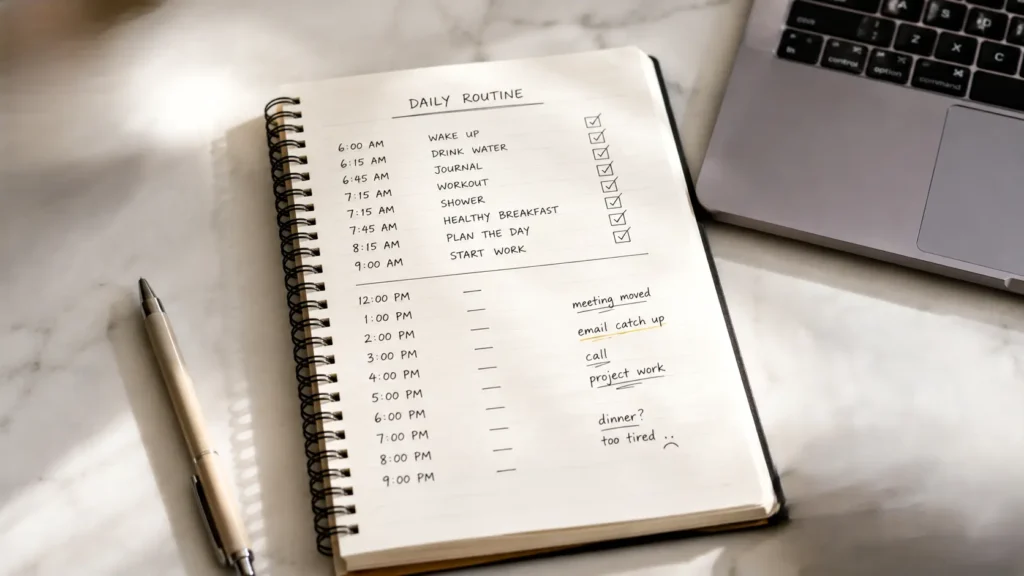
Most advice on routines focuses heavily on the morning: wake up early, drink water, journal, exercise, and start the day with a clear plan. While these habits can create a strong beginning, they don’t address what happens once the day is underway.
Work demands change, meetings run longer than expected, and planned breaks often get replaced by another task. As the afternoon progresses, your energy and focus can also decline, making it harder to stay consistent with the priorities you set earlier in the day.
A morning routine can give you a strong start, but it cannot structure the entire day on its own.
Work has a way of interrupting even a well-planned morning. That’s why a practical routine needs a few points of structure after breakfast too, especially around the parts of the day when your focus, boundaries, or energy tend to slip.
The Three Points Where Your Day Actually Falls Apart
Most days don’t collapse all at once. Instead, they usually lose momentum at three specific points.
1. The midday slump
For many people, somewhere between 1 and 3 PM, focus starts to dip, and even simple tasks can feel harder than they should. This isn’t necessarily a discipline problem. It’s a predictable part of the day that can be easier to manage when you plan around it rather than constantly fighting through it.
2. The post-work transition
You close your laptop, but your brain doesn’t always close with it. Work thoughts follow you into the kitchen, the shower, or the couch because nothing has clearly marked the end of the workday.
3. The evening wind-down that never arrives
You mean to read, stretch, or simply sit still for a few minutes. But instead, you end up scrolling, half-watching something, and staying awake later than you intended without really knowing why.
These are the moments worth building around because they tend to happen even when the rest of your schedule changes.

How to Build a Daily Routine That Works for You
If you’re wondering how to build a daily routine that survives a real, unpredictable day, don’t start by planning every hour. Build it around anchors: fixed points that you return to, no matter how the rest of the day goes.
Start with one anchor for each point where your day tends to lose momentum:
1. Midday:
Take a 10-minute break away from your screen at roughly the same point in your day. You don’t need to fill it with another task. Walk around, eat something away from your desk, or simply sit somewhere else for a few minutes. The point is to interrupt the work cycle before you’re completely drained.
2. Transition:
Choose one small, physical signal that tells your brain work has ended. You could change your shirt, take a five-minute walk, or close your laptop and put it in another room. The specific action matters less than doing it consistently.
3. Evening:
Choose one thing that happens before your phone does. It could be drinking water, reading a page of a book, dimming the lights, or following a simple self-care ritual. Keep it small enough that doing it feels easier than putting it off.
You don’t need a rigid schedule or fourteen different habits. Three useful anchors are enough to give your day some structure.
Making a Daily Routine: Building Anchors, Not Schedules
A schedule tells you exactly what to do at 4:15 PM on a Tuesday. Real life rarely runs with that kind of precision. When a meeting runs late or something unexpected happens, the schedule can become one more thing you feel behind on.
Anchors work differently. If you’re learning how to make routines that actually survive real life, think of them as flexible points rather than exact times.
Your midday break might happen at 1:40 PM one day and 2:50 PM the next. What matters is that you step away rather than skipping it altogether.
That flexibility matters when meetings move, errands run late, or your energy changes. You’re giving your day a few reliable points to return to without trying to control every hour.
That’s the real difference between a routine that survives a bad week and one that falls apart the first time your schedule changes.
How Your Morning Routine Supports Healthy Routines
If your mornings are already sorted, keep them exactly as they are. If you still need to build that foundation, start with our [morning routine for busy women].
The important thing is that you don’t need to rebuild your entire day at once. A morning routine gives you a starting point, while these anchors help carry that structure into the hours when work, errands, and low energy start getting in the way.
Because of that, the anchors should be smaller and more flexible than anything you might do first thing in the morning.
You’re not creating a completely new lifestyle. You’re extending the parts of your existing routine that already work into the hours where you usually lose momentum.

A Realistic Full-Day Framework
If you’re wondering how to build a good daily routine, it can help to see the anchors as part of your existing day rather than as a separate list of habits.
1. Morning:
Keep whatever is already working. There’s no need to add five new habits just because you’re working on the rest of your day.
2. Midday:
Step away from your screen for around 10 minutes. The timing can move depending on meetings and workload.
3. Transition:
Once work is finished, use the same small physical signal each day. Change your clothes, take a short walk, or put your laptop somewhere you won’t see it.
4. Evening:
Do one small thing before reaching for your phone. Read a page, drink some water, dim the lights, or follow a simple self-care ritual.
The point is not to complete all four perfectly. They simply give the day a few places to reset when everything else is moving around.
What to Do When Your Routine Falls Apart
Some days, one of these anchors will disappear completely. A meeting will run over, lunch will get pushed back, or you’ll get home too tired to do anything except sit down.
That doesn’t mean you need to restart the entire routine the next morning.
Instead, return to the next anchor that still makes sense. If midday disappeared, keep your evening transition. If the evening became chaotic, simply return to your morning routine the next day.
Don’t treat one missed anchor as proof that the entire routine isn’t working. The goal isn’t to protect every anchor every single day. It’s to make your day easier to recover when one of them slips.
That’s what makes this approach useful when you have no time. You aren’t building a perfect schedule. You’re creating a few reliable points that help you regain your footing when the day inevitably gets messy.
FAQ
How long does it take to build a new routine?
There isn’t a fixed timeline. For many people, a couple of weeks is enough for new anchors to start feeling more familiar, but consistency matters more than the exact number of days. The first week may feel uneven, especially if your schedule changes. That’s part of figuring out which habits actually fit your life.
What are some daily routine examples for adults?
A realistic routine might include a morning routine that helps you get started, a midday anchor that breaks up the workday, and another anchor that helps you transition into the evening. The exact habits will depend on your schedule, but the structure can stay simple enough to adjust when your day changes.
Do I need a morning routine before I can do this?
No, these anchors can work independently of what your mornings look like. If your mornings still feel chaotic, you can start there first, but you don’t have to wait until everything else is organized. Start with one anchor that solves the part of your day currently causing the most friction.