

The basic morning and night skincare routine order is cleanse, treat, and moisturize, with sunscreen as the final step in the morning. Toner and facial oil are optional, and the treatments you use at night should depend on your skin concerns and the product instructions.
Here is how to layer each product, what changes between morning and night, and which steps you can skip.
Why Order Matters: Thinnest to Thickest
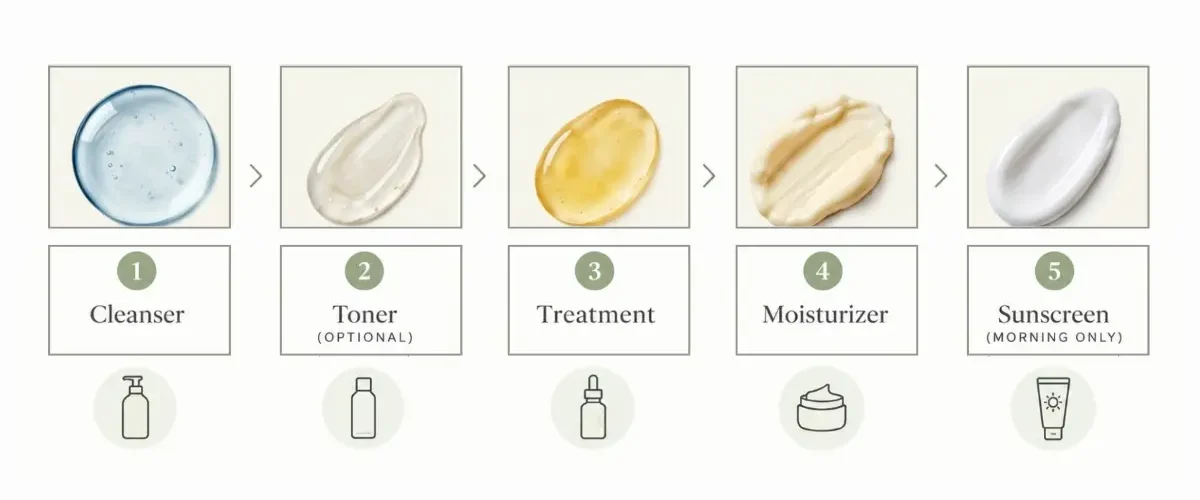
- Apply lighter, water-based products before richer creams and oils as a general rule.
- Texture alone does not determine the order for every product. Follow specific treatment instructions, especially for prescription products, when they differ from the usual sequence.
- Apply sunscreen after moisturizer as the final skincare step in the morning, before makeup.
- For more detail, see the American Academy of Dermatology’s guidance on the order of skincare products.
The Order of Morning Skincare Routine, Step by Step
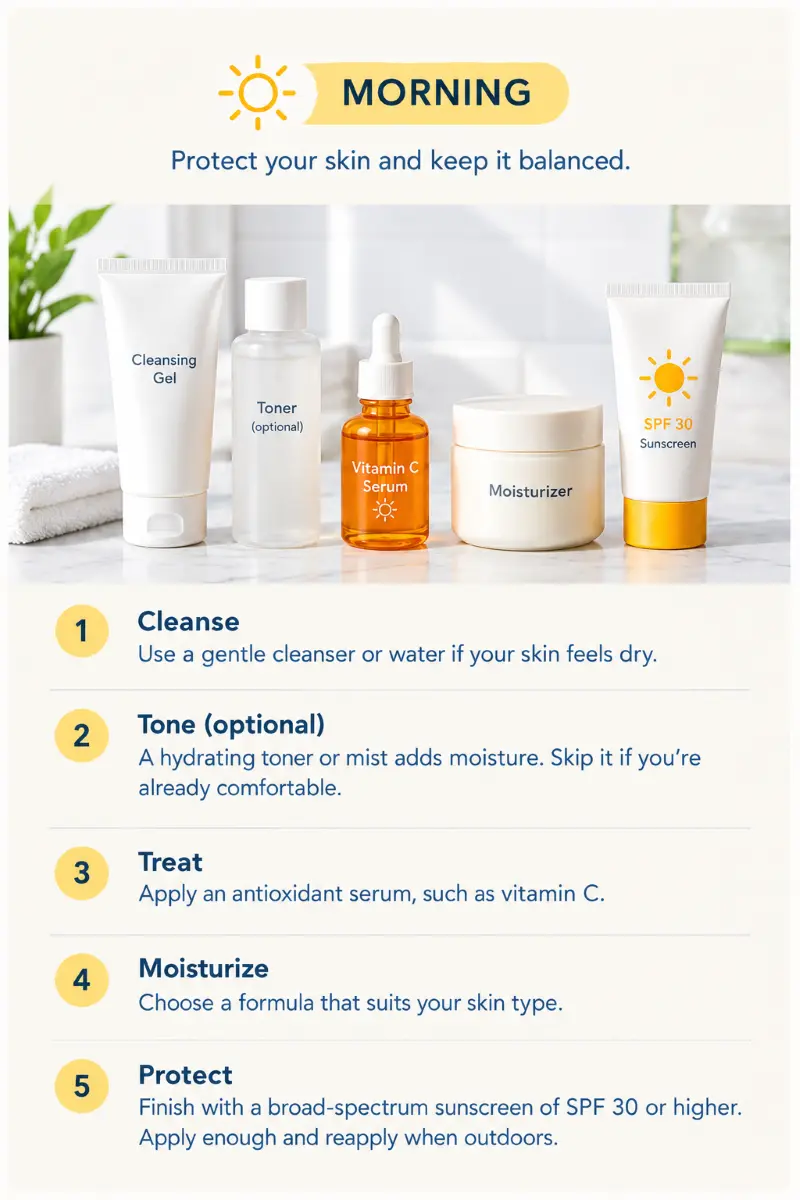
If you have searched for a morning routine skincare order that feels simple enough to follow every day, start with this sequence. The morning skincare routine order does not need to include every product; keep the steps that serve a purpose for your skin.
1. Cleanser
Use a gentle cleanser to remove oil and overnight buildup. If your skin feels dry in the morning, rinsing with water may be enough.
2. Toner (Optional)
A hydrating toner or mist can add moisture. Skip it if your cleanser and moisturizer already leave your skin comfortable.
3. Targeted Serum
Apply a targeted serum, such as vitamin C, after cleansing. Vitamin C is commonly used in the morning to help address dullness and uneven-looking skin tone.
4. Moisturizer
Choose a formula suited to your skin. A lightweight lotion or gel may work well for oily or combination skin, while dry skin may prefer a richer cream.
5. Sunscreen
Finish with a broad-spectrum sunscreen of SPF 30 or higher. Apply enough to cover all exposed skin. When outdoors, reapply at least every two hours and after swimming or sweating, following the product instructions. Apply makeup after sunscreen.
Your Night Skincare Routine Order
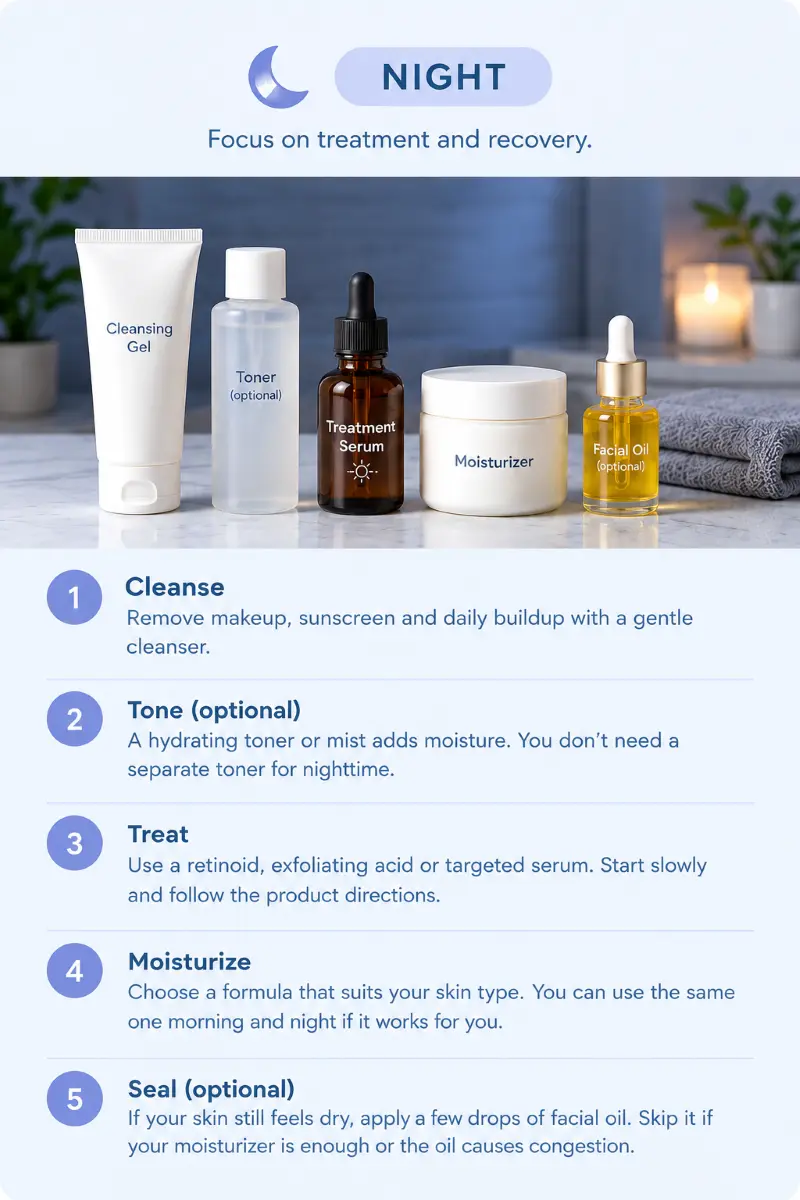
The skincare routine order morning and night follows the same basic sequence, but nighttime is a common place for targeted treatments. You do not need a completely separate set of products for every step.
1. Cleanser
Remove makeup, sunscreen, and daily buildup with a gentle cleanser that leaves your skin comfortable.
2. Toner (Optional)
Use a hydrating toner or mist if it adds something useful to your routine. A separate nighttime toner is not necessary.
3. Targeted Treatment
Choose a treatment based on your skin concern and the product instructions.
– Retinoids
Can help with acne and signs of skin aging, depending on the product. They can irritate skin, so beginners should start gradually and follow the product instructions. Avoid retinoids during pregnancy.
– Exfoliating Acids
Can help improve rough texture, depending on the ingredient and formulation. Follow the product directions rather than assuming every acid belongs at night.
– New Active Ingredients
Introduce one new treatment at a time to see how your skin responds. Combining active ingredients depends on the ingredients, their strengths, and your skin’s tolerance.
4. Moisturizer
Choose a moisturizer that suits your skin type. You can use the same one morning and night if it keeps your skin comfortable.
5. Facial Oil (Optional)
If your skin still feels dry after moisturizing, consider facial oil as a final layer. Skip it if your moisturizer is enough or the oil does not suit your skin.
Morning Skincare Routine vs. Night: What Changes?
The foundation stays the same: cleanse, treat, and moisturize. The biggest difference is morning sun protection versus nighttime treatment.
| Step | Morning | Night |
|---|---|---|
| Cleanse | Gentle cleanser or water if sufficient | Gentle cleanser to remove makeup and sunscreen |
| Tone | Optional hydrating toner | Optional hydrating toner |
| Treat | Optional targeted serum, such as vitamin C | Optional retinoid, exfoliating acid, or targeted serum |
| Moisturize | Formula suited to your skin | Same moisturizer or another suitable formula |
| Protect | Broad-spectrum sunscreen, SPF 30 or higher | Not a routine step |
| Facial oil | Usually unnecessary | Optional if needed |
If you own only a cleanser, moisturizer, and sunscreen, you already have the essentials for a simple routine. You can add a treatment later if you have a specific concern to address.
Which Treatment Fits Your Skin Concern?

Choose a treatment based on the concern you want to address, rather than adding several active ingredients simply because they are popular.
| Dullness or uneven-looking skin tone: A vitamin C product may be worth considering if it suits your skin. |
| Acne or persistent breakouts: Choose a treatment designed for acne. If breakouts are persistent, painful, or causing scars, a dermatologist can help you choose an appropriate option. |
| Rough texture or fine lines: A retinoid or exfoliating product may help, depending on your skin and its tolerance. |
You do not need all three. Start with one treatment that addresses your main concern, and learn how your skin responds before adding another. If your current routine is working, there is no need to add a treatment just to make it more complete.
If you have very dry, red, or easily inflamed skin, ask a dermatologist before starting a retinoid or strong exfoliating treatment. Retinoids should not be used during pregnancy.
Order Mistakes That Undo Your Routine
Most skincare routines do not need more products. They need a clearer order and fewer unnecessary steps.
If you have acne, eczema, another skin condition, or use a prescription treatment, ask your dermatologist before making significant changes to your routine.
Once the order is clear, the next step is choosing products that earn their place in your routine. Our guide to self-care products I actually use every week shares products with a practical place in everyday life.
For habits beyond skincare, explore how to build a daily routine and our morning routine for busy women.
Frequently Asked Questions
Does serum go before or after moisturizer?
Serum generally goes before moisturizer because many serums have lighter formulations. Apply moisturizer afterward. If the product directions specify a different order, follow those directions.
Can I use the same skincare routine for morning and night?
Partly, you can use the same cleanser and moisturizer at both times. Your morning routine includes sunscreen, while night time is a common time for targeted treatments such as retinoids. The exact routine depends on your skin and the products you use.
Do you need a morning and night skincare routine?
A basic routine is useful. Sunscreen in the morning helps protect your skin from UV exposure, and cleansing at night removes sunscreen, makeup, and daily build up. You do not need a long routine to cover these basics.
Should sunscreen go on before or after moisturizer?
Sunscreen goes after moisturizer. It is the final skincare step in the morning, followed by makeup if you wear it.
How long should I wait between skincare steps?
There is no universal waiting time between ordinary skincare steps. Let each layer settle enough to apply the next one comfortably without pilling. Follow specific product directions when they require a particular wait, especially for prescription treatments.